



- ISSN: 0921-5077
- E-ISSN: 1875-7235
Access full text
Article
-
OACall for papers voor G&O-themanummer 2026: Existentialisme in de arbeids- en organisatiepsychologie
-
Authors:
Bram Fleuren1
 , Robert Blomme2, Evgenia Lysova3 & Herman Steensma4
- Publisher: Amsterdam University Press
- Source: Gedrag & Organisatie, Volume 39, Issue 1, Mar 2026, p. 152 - 159
- DOI: https://doi.org/10.5117/GO2026.1.007.FLEU
- Language: Dutch
-
- Published online: 01 Mar 2026
Preview this article:
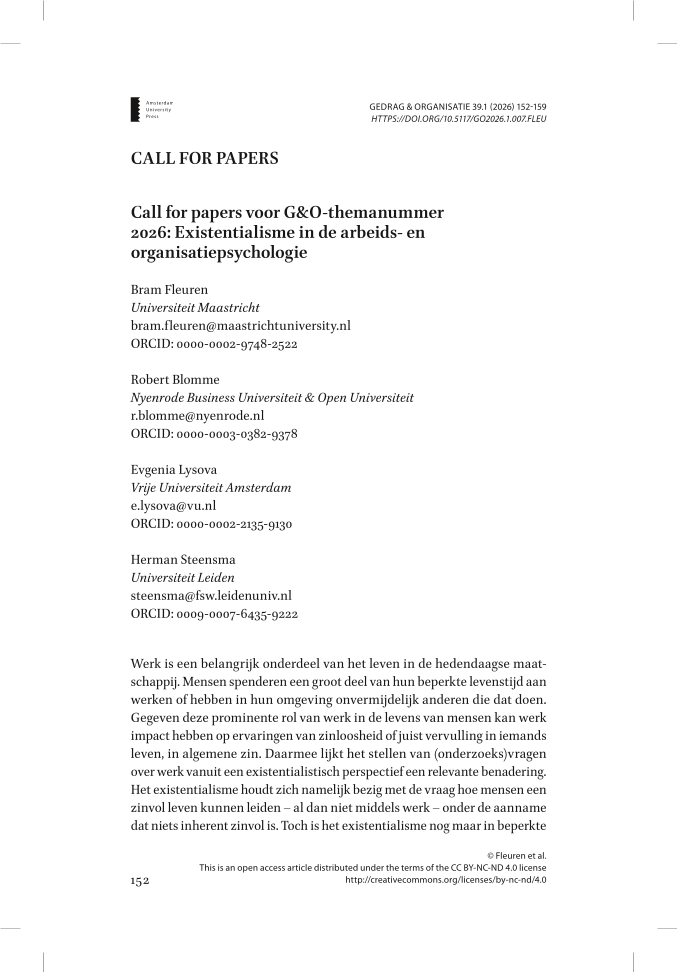


Call for papers voor G&O-themanummer 2026: Existentialisme in de arbeids- en organisatiepsychologie, Page 1 of 1
< Previous page | Next page > /docserver/preview/fulltext/09215077/39/1/GO2026.1.007.FLEU-1.gif
There is no abstract available.
© Fleuren et al.

Article metrics loading...
/content/journals/10.5117/GO2026.1.007.FLEU
2026-03-01
2026-03-22
Full text loading...
/deliver/fulltext/09215077/39/1/GO2026.1.007.FLEU.html?itemId=/content/journals/10.5117/GO2026.1.007.FLEU&mimeType=html&fmt=ahah
[Citing articles]
[Web of Science]
[Medline]
References
-
Baum, J., & Singh, J. (1994). Organization-environment coevolution. In J.Baum & J.Singh (Eds.), Evolutionary dynamics of organizations (pp. 379-402). Oxford University Press.
-
Blomme, R. J., & Bornebroek-Te Lintelo, K. (2012). Existentialism and organizational behaviour. Journal of Organizational Change Management, 25(3), 405-421. https://doi.org/10.1108/09534811211228120
-
Both-Nwabuwe, J. M. C., Dijkstra, M. T. M., & Beersma, B. (2017). Sweeping the floor of putting a man on the moon: How to define and measure meaningful work. Frontiers in Psychology, 8, 1658. https://doi.org/10.3389/fpsyg.2017.01658
-
Camus, A. (1942). Le mythe de Sisyphe. Éditions Gallimard.
-
De Beauvoir, S. (1949). Le deuxième sexe. Gallimard.
-
Fleuren, B. P. I., Rodriguez Conde, C., & Gifford, R. E. (2024). Estranged, nauseated, or fulfilled? Existentialism as bridge between antiwork and I-O psychology. Industrial and Organizational Psychology, 17(1), 39-44. https://doi.org/10.1017/iop.2023.79
-
Frankl, V. E. (1946). Ein Psychologe erlebt das Konzentrationslager. Verlag für Jugend und Volk.
-
Greenberg, J. (2012). Terror management theory: From genesis to revelations. In P. R.Shaver & M.Mikulincer (Eds.), Meaning, mortality, and choice: The social psychology of existential concerns (pp. 17-35). American Psychological Association. https://doi.org/10.1037/13748-001
-
Greenberg, J., Koole, S. L., & Pyszczynski, T. (2004). Handbook of experimental existential psychology. The Guilford Press.
-
Heidegger, M. (1927). Sein und Zeit. Max Niemeyer Verlag.
-
Husserl, E. (1936). Die Krisis der europäischen Wissenschaften und die transzendentale Phänomenologie: Eine Einleitung in die phänomenologische Philosophie. Felix Meiner Verlag.
-
Jaspers, K. (1932). Philosophie. Springer.
-
Kierkegaard, S. (1849). Sygdommen til døden [De ziekte tot de dood]. C. A. Reitzel.
-
Koole, S. L., Greenberg, J., & Pyszczynski, T. (2006). Introducing science to the psychology of the soul. Current Directions in Psychological Science, 15(5), 212-216. https://doi.org/10.1111/j.1467-8721.2006.00438.x
-
Lips-Wiersma, M., & Morris, L. (2009). Discriminating between ‘meaningful work’ and the ‘management of meaning’. Journal of Business Ethics, 88, 491-511. https://doi.org/10.1007/s10551-009-0118-9
-
Loonstra, B., Brouwers, A., & Tomic, W. (2009). Feelings of existential fulfilment and burnout among secondary school teachers. Teaching and Teacher Education, 25, 752-757. https://doi.org/10.1016/j.tate.2009.01.002
-
May, R. (1950). The meaning of anxiety. The Ronald Press Company.
-
Nietzsche, F. W. (1886). Jenseits von Gut und Böse: Vorspiel einer Philosophie der ZukunftC. G. Naumann.
-
Pascal, B. (1670). Pensées. Jean Desbarreaux
-
Pines, A. M. (1993). Burnout: An existential perspective. In W. B.Schaufeli, C.Maslach, & T.Marek (Eds.), Social issues and questions. Professional burnout: Recent developments in theory and research (pp. 33-51). Taylor & Francis.
-
Pines, A. M., & Keinan, G. (2005). Stress and burnout: The significant difference. Personality and Individual Differences, 39(3), 625-635. https://doi.org/10.1016/j.paid.2005.02.009
-
Pines, A. M., & Zaidman, N. (2014). Stress and burnout in bicultural teams in hi-tech industry. British Journal of Management, 25(4), 819-832. https://doi.org/10.1111/1467-8551.12056
-
Saccarelli, E. (2007). Alone in the world: The existential Socrates in the apology and crito. Political Studies, 55(3), 522-545. https://doi.org/10.1111/j.1467-9248.2007.00672.x
-
Sartre, J. (1946). L’existentialisme est un humanisme. Les Editions Nagel.
-
Sartre, J. P. (1943). L’être et le néant. Gallimard.
-
Tomic, W., & Tomic, E. (2008). Existential fulfillment and burnout among principals and teachers. Journal of Beliefs & Values, 29(1), 11-27. https://doi.org/10.1080/13617670801928191
-
Wong, P. T. (2010). What is existential positive psychology? International Journal of Existential Psychology and Psychotherapy, 3(1), 1-10.
-
Yalom, I. D. (1980). Existential psychotherapy. Basic Books.
/content/journals/10.5117/GO2026.1.007.FLEU
- Article Type: Announcement
Most Read This Month
Article
content/journals/09215077
Journal
5
3
false
en