


- Home
- Publicaties
- Algemeen Nederlands Tijdschrift voor Wijsbegeerte
- Eerder verschenen
- Volume 118, Nummer 1, 2026
Algemeen Nederlands Tijdschrift voor Wijsbegeerte - Volume 118, Nummer 1, 2026
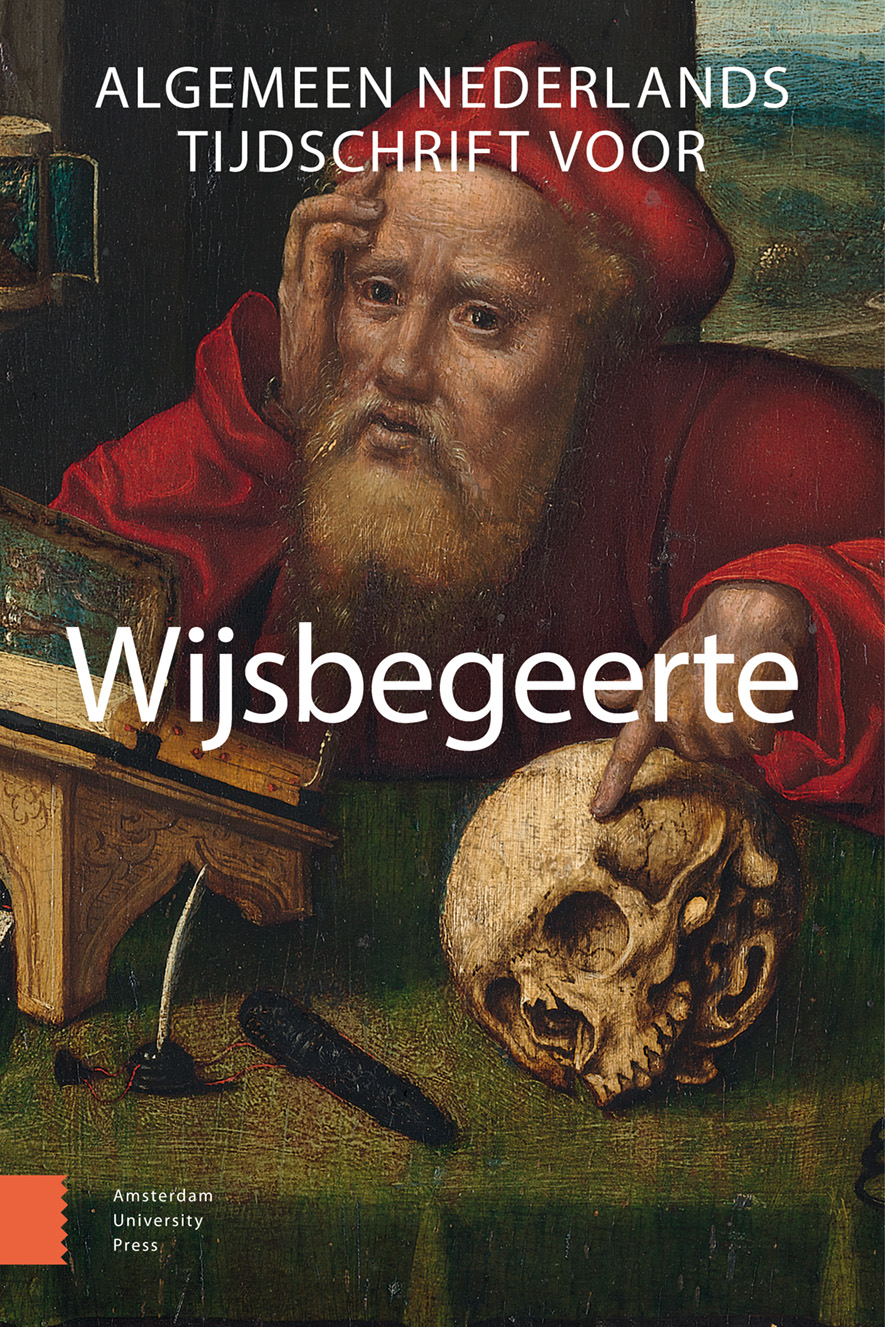
Volume 118, Nummer 1, 2026
- Redactioneel
-
- Artikel
-
-
-
Onszelf in eetbare termen begrijpen in het Afvalceen
Meer MinderAuteur: Lisa DoelandAbstractConceiving of Ourselves in Edible Terms in the Wasteocene
Considering that disposability is the defining feature of the age we live in, it can be characterized best as the Wasteocene (Armiero). Where the Anthropocene is read in geological strata, the Wasteocene must be read in bodies, some of which have become a dump (of plastics, PFAS, pesticides, et cetera) more than others. How to move away from the waste-making relationships that characterize the Wasteocene, that are slowly but steadily turning to world into a non-life giving dump and instead move to place-making relationships? This requires we once again conceive of ourselves in edible terms (Plumwood) and ask how we can learn to eat and give to eat well, which starts already in the womb. Following Jacques Derrida’s ethical command “il faut bien manger” (one must eat well/one must eat the good/it is good to eat), I figure this eating and giving to eat from the perspective of “eating one’s mother” or matrotrophy (Simms) and argue this requires we give to eat generously, with generativity and generations in mind. What do we give to eat to future generations and does that digest well?
-
-
-
-
Denken met de rivier: De milieufilosofie van Tanaka Shōzō
Meer MinderAuteur: Kristien HensAbstractThinking with the River: The Environmental Philosophy of Tanaka Shōzō
This article explores the environmental philosophy of Tanaka Shōzō, a pioneering Japanese environmentalist during the Meiji era (1868-1912). Tanaka’s response to the ecological and social devastation caused by the Ashio copper mine offers a unique perspective on the relationship between humanity, nature, and technology. His philosophy, especially his ideas on nagare (flow) and doku (poison) emphasizes the interconnectedness of ecological and social systems. I argue that it can offer an alternative to dualistic approaches to nature and is a fruitful addition to contemporary environmental ethics and biotechnology. Specifically, I suggest that Tanaka’s emphasis on an intimate understanding of and collaborative engagement with natural systems can inspire a more reflective and sustainable approach to science and biotech.
-
-
-
‘Ik neem mijn toevlucht tot Moeder Aarde’ en ‘Wij zijn de Aarde’. De interacties tussen filosofie en ritueel in boeddhistische Aarde-aanrakingen
Meer MinderAuteur: Deborah de KoningAbstract‘I Take Refuge in Mother Earth’ and ‘We are the Earth’: The Mutual Shaping of Philosophy and Ritual in Buddhist Earth Touching
This article discusses the relevance of Yogācāra Buddhist philosophy and prostration in times of climate change by analyzing the ritual of Earth Touching. Earth Touching emerged within the branch of Western Buddhism known as Plum Village. In the Netherlands, the ritual is conducted by climate-engaged people who are familiar with Buddhism but do not necessary self-identify as Buddhists. Earth Touching as practiced in the context of climate change discloses how selected Buddhist (philosophical) practices on the one hand and perspectives on the relationships between humans and the world as raised in the context of climate change on the other hand mutually shape each other. In this process a multiplicity of, sometimes conflicting, perspectives emerges. In general, this article makes a case for the study of Buddhist practices to understand the relevance of Buddhist philosophy for social issues and its broader appeal to non-Buddhists.
-
-
-
Schrijvend de mens uitwissen
Meer MinderAuteur: Boris R. van MeursAbstractThe human effaced by writing
In contemporary literary discussions about climate fiction, it is often argued that the alleged anthropocentrism of literature hinders it from fruitful engagement with nonhuman elements of the ecological crisis. While critics have defended literature against this claim by appealing to particular literary techniques to narrate the nonhuman world, in this article, I explore the material non-anthropocentrism of literature through an interpretation of Blanchot’s “Literature and the Right to Death”. For Blanchot, literature is ultimately an ambiguous phenomenon that both at once expresses the power of human imagination and its limitations. These limitations become manifest mostly in the materiality of literary writing, which is a precondition for literary meaning to arise, but, according to Blanchot, never becomes meaningful itself. This material side to literature accompanies but escapes human action and imagination, highlighting their inevitable non-anthropocentric sides. While Blanchot’s non-anthropocentrism does not provide new guidelines for action, it can function as a humbling reflection on the limits of human agency.
-
-
-
Onderwijs als filosofisch strijdperk: van polarisatie naar pluralisme en planetair bewustzijn
Meer MinderAuteur: Caroline SuranskyAbstractEducation as a Philosophical Battleground: From Polarization to Pluralism and Planetary Awareness
In an era marked by ecological crises and rising inequality, education has become a contested ideological space. This article argues that education is not merely a site of knowledge transmission but a philosophical battleground where competing worldviews and concepts of justice, humanity and our relationship to the Earth collide. Analyzing the discursive entanglement of anti-woke rhetoric, climate skepticism, and nationalist educational agendas, the article discusses how these narratives construct exclusionary identities and oppose pluralist reform efforts. Drawing on Appadurai’s globalization theory, decolonial thinkers such as Mbembe and Mignolo, and the philosopher Latour’s critique of modernity, I propose to reimagine education as a space for epistemic justice, ethical awareness, and ecological entanglement. Through three practice-based case studies, a Latour-inspired Atelier, the ‘Woke and Resistance’ project at the University of Humanistic Studies in the Netherlands, and a South African citizen science on water, the article explores how education can resist polarizing logics and instead cultivate relational, inclusive, and situated learning. It concludes by advocating a pedagogy of epistemic humility and pluralism by positioning education as key to navigate complexity and co-flourishing in the Anthropocene.
-
-
-
De onderbelichte rol van ‘verdienste’ in de politieke filosofie van G.A. Cohen
Meer MinderAuteur: Thomas BaijotAbstractThe Underexposed Role of ‘Desert’ in the Political Philosophy of G.A. Cohen
Although the notion of desert occupies a prominent place in our common sense thinking about moral and political issues, it is notably absent from dominant theories of justice. This article examines the role of desert in the works of G.A. Cohen, a radical egalitarian and key theorist of justice. This study highlights that desert is an underexposed aspect of Cohen’s thinking. Desert is rarely associated with Cohen’s philosophy or his work is often misinterpreted in this regard. I demonstrate that, contrary to David Miller’s claims, desert is an essential concept for understanding Cohen’s philosophy. In an unpublished critique of Miller and one of his earliest contributions to normative political philosophy, Cohen defends an effort theory of desert; those who work more deserve a higher income. Nevertheless, in the same article, Cohen seems to express scepticism about the notion of desert. However, in Cohen’s later contributions, he revisits the concept, broadening its role and making it central to his theory of justice. Firstly, a shift can be observed within Cohen’s luck egalitarianism, the theory he supports: while choices or control initially serve as its sole normative basis, desert later gains significance. Secondly, Cohen implicitly defends a compensation theory of desert; those with a higher labor burden deserve compensation. This article contributes both to the understanding of G. A. Cohen’s egalitarian philosophy and the broader debate on justice and desert.
-
Most Read This Month

Meest geciteerd Most Cited RSS feed
-
-
Philosophy and Wisdom
Auteur: Peter Jonkers
-
-
-
A praise of pain
Auteur: Giulia Sissa
-
- More Less