


Algemeen Nederlands Tijdschrift voor Wijsbegeerte - Volume 114, Issue 1, 2022
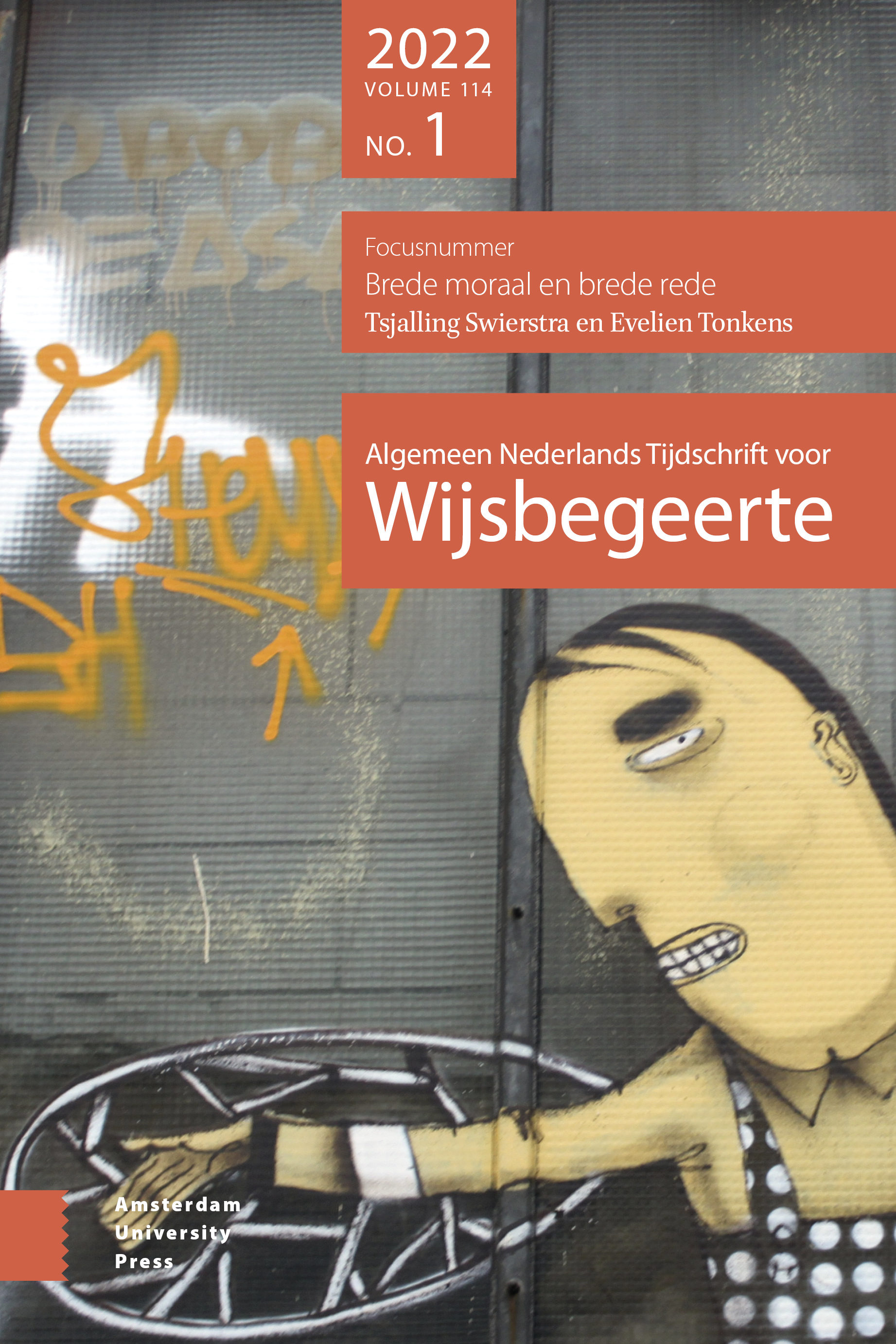
Volume 114, Issue 1, 2022
-
-
Brede moraal en brede rede
show More to view fulltext, buy and share links for:Brede moraal en brede rede show Less to hide fulltext, buy and share links for: Brede moraal en brede redeAuthors: Tsjalling Swierstra & Evelien TonkensAbstractBroad Morals and Broad Reason: Reconciling inclusive ethics with psychological realism
Many of today’s problems revolve around distance and proximity. Progressives argue that a universalist, inclusive ethics requires us to bridge distances in identity, space, and time. Conservatives object that such bridging is psychologically unrealistic: people of flesh and blood can only care about whom/what is close-by. Evolutionary and psychological research seems to corroborate this sobering view. Many researchers confirm that our intuitions (‘System 1’) are groupish and short-sighted, and largely deaf to the appeal of rational universalism (‘System 2’).
But not all agree. We distinguish four ‘evo-progressive’ attempts to reconcile evolution and psychology with a universalist, inclusive ethics. Singer and Pinker (1), Buchanan and Powell (2), and Sunstein (3) contend that a reason-based, inclusive ethics is psychologically feasible, but that such an ethics has to be thin, solely focusing on rights and no-harm. By contrast, Haidt (4) argues that an inclusive ethics should be ‘broad’, also encompassing moral domains like sacrality, loyalty and authority. This implies for him that it cannot be reason-based.
We argue that a broad form of inclusive ethics can and should be reason-based, but that this requires a rethinking of ‘reason’. We show that the evo-progressives’ conviction that a rational ethics is by definition thin, results from their theoreticistic conception of reason. But reason can also have more mimetic-embodied or mythical-narrative forms. These do allow for a broad, rational, inclusive ethics that can motivate real people to include stakeholders that are distant in identity, place, and time.
-
-
-
Pluraliteit organiseren vraagt niet om inclusief universalisme
show More to view fulltext, buy and share links for:Pluraliteit organiseren vraagt niet om inclusief universalisme show Less to hide fulltext, buy and share links for: Pluraliteit organiseren vraagt niet om inclusief universalismeAuthors: Femke Takes & Jan Bransen
-
-
-
Institutionele voorwaarden voor een brede, inclusieve rede
show More to view fulltext, buy and share links for:Institutionele voorwaarden voor een brede, inclusieve rede show Less to hide fulltext, buy and share links for: Institutionele voorwaarden voor een brede, inclusieve redeAuthors: Evelien Tonkens & Tsjalling Swierstra
-
-
-
Kate Kirkpatrick (2020), Simone de Beauvoir. Een leven, Utrecht: Ten Have, 496 pp., € 34,95 (hardback) / € 24,99 (paperback).
show More to view fulltext, buy and share links for:Kate Kirkpatrick (2020), Simone de Beauvoir. Een leven, Utrecht: Ten Have, 496 pp., € 34,95 (hardback) / € 24,99 (paperback). show Less to hide fulltext, buy and share links for: Kate Kirkpatrick (2020), Simone de Beauvoir. Een leven, Utrecht: Ten Have, 496 pp., € 34,95 (hardback) / € 24,99 (paperback).Author: Silke Currinckx
-
-
-
Walter Benjamin (2020), Kritische portretten. Twaalf essays over literatuur, Amsterdam: Octavo, 271 pp., € 22,50.
show More to view fulltext, buy and share links for:Walter Benjamin (2020), Kritische portretten. Twaalf essays over literatuur, Amsterdam: Octavo, 271 pp., € 22,50. show Less to hide fulltext, buy and share links for: Walter Benjamin (2020), Kritische portretten. Twaalf essays over literatuur, Amsterdam: Octavo, 271 pp., € 22,50.Author: Leen Verheyen
-
Most Read This Month

Most Cited Most Cited RSS feed
-
-
Philosophy and Wisdom
Author: Peter Jonkers
-
-
-
A praise of pain
Author: Giulia Sissa
-
- More Less